
Saipem FlatFish AUV Targets CO2 Leak Detection with Year-Long Seabed Residency
Categories: Author: MarineConn Views: 46
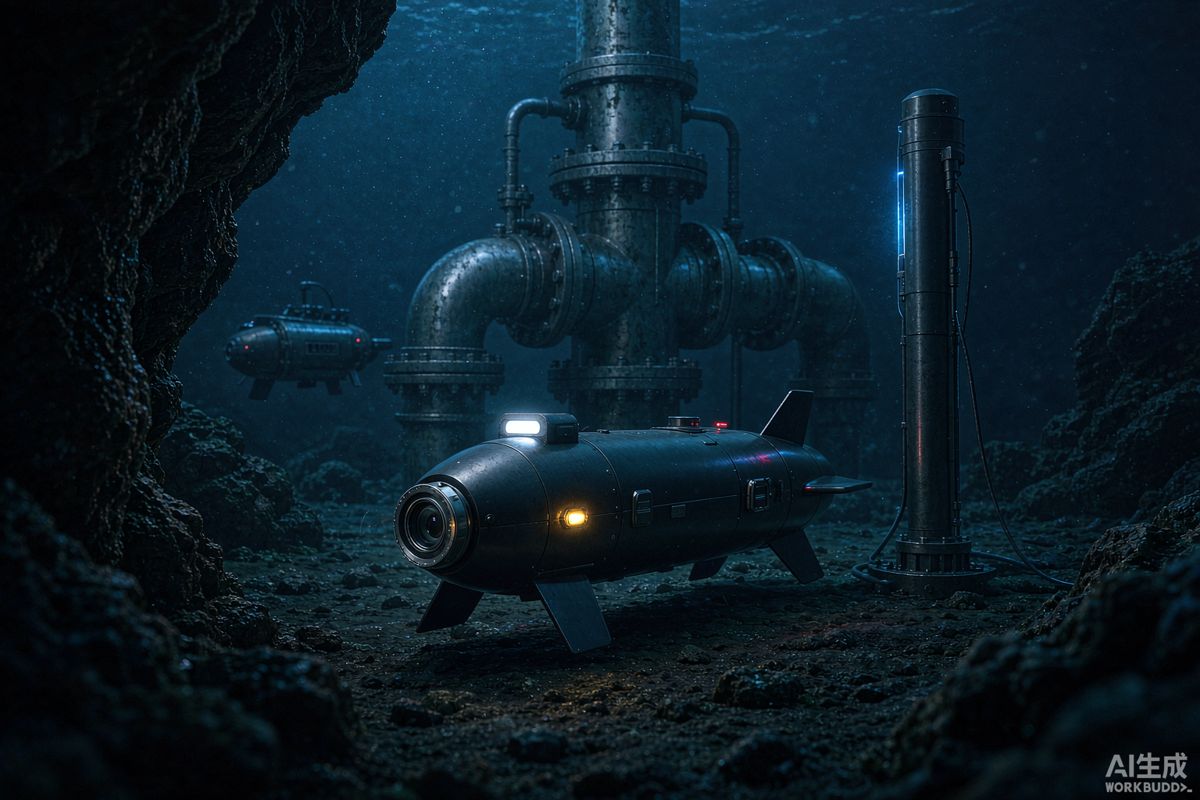
Saipem's FlatFish pairs an AUV with seabed docking stations to monitor CO2 storage sites for up to twelve months — a residency model that changes what subsea connectors must survive.
From Inspection Missions to Continuous Residency
On 15 October 2026, Saipem demonstrated its FlatFish autonomous underwater vehicle at its Trieste base in Italy before more than 70 representatives from industrial partners, research centres, institutions and European stakeholders. The vehicle's assignment is specific and commercially significant: detecting potential CO₂ leaks at offshore carbon capture and storage sites, and inspecting the subsea transport infrastructure that feeds them.
FlatFish is part of Saipem's Hydrone programme — an ecosystem of AI-enabled subsea robots. The operating model is the part worth studying: the company states these systems can operate continuously for up to 12 months by alternating inspection missions with recharging at subsea docking stations.
Why Residency Changes the Hardware Equation
A conventional AUV campaign is a sequence of discrete events: mobilise, dive, recover, download, service. Residency breaks that cycle. The vehicle stays in the water, returning to a docking station for power and data transfer rather than to a vessel deck.
For subsea hardware, four consequences follow directly:
- Wet-mate interfaces see far more cycles. Docking is a mating event. Twelve months of residency can mean hundreds of connect-disconnect cycles at the vehicle-to-dock interface, with biofouling present at every one of them;
- Power transfer becomes a design constraint. Inductive or wet-mate contact charging both require a repeatable, self-aligning interface that tolerates positional error in low visibility;
- Sealing must survive continuous immersion. Elastomer compression set, marine growth on sealing faces, and sediment ingress replace the handling damage that dominates short-campaign failures;
- Data offload concentrates in short windows. High-volume optical or sonar data moves during dockings, pushing bandwidth requirements onto a connection that may only be made a few hundred times over the asset life.
The Data Architecture Behind It
Saipem is contributing its robotics platform and Seanapsys — a subsea architecture for data acquisition, processing and point-to-point transmission — to COREu, an EU Horizon Europe initiative coordinated by SINTEF Energy Research with more than 40 industrial and scientific partners. The programme's remit is safe, reliable and scalable infrastructure for CO₂ capture, transport and storage.
Leak detection is the integrity backbone of that remit. Operators of offshore storage must demonstrate that stored CO₂ remains where it was placed, and that transport infrastructure has not degraded — a monitoring obligation that extends over decades, not campaigns. Point-to-point subsea transmission is what turns a vehicle's sensor readings into an auditable integrity record.
What This Means for Connector and Cable Buyers
Three practical takeaways:
- Cycle life is overtaking depth rating as the key specification. For resident vehicles and docking stations, mating-cycle endurance, seal-wipe geometry and anti-biofouling provisions matter more than a headline depth figure;
- Docking stations are becoming standard infrastructure. Each station is itself a subsea node requiring power connectors, data connectors and a protected cable interface — a new product category rather than a one-off custom build;
- CCUS is a genuine new demand vertical. Storage monitoring adds a decade-scale operational requirement on top of the survey and inspection markets, and it is being funded through EU programmes rather than single-operator budgets.
MarineConn for Resident and Docking Architectures
MarineConn builds underwater connectors rated for repeated wet mating, subsea cable assemblies with moulded terminations for long-immersion service, flat connectors where low-profile penetrations are required, and cable winches for tethered and hybrid operations. For docking-station programmes, we can specify cycle-rated interfaces and provide test data for seal performance under continuous immersion.
Designing a resident AUV or docking node? Contact our engineering team to discuss mating-cycle requirements, depth ratings and cable assembly options.
Source: Saipem release on FlatFish CO₂ leak detection demonstration, Trieste, 15 October 2026; COREu programme information.